April 30, 2014

Pride and Joy, Coast to Coast

Parents tend to be very predictable people, especially the ones actively involved with their children. We want them to do better than us, and to live their lives by our shared values. The success of the first is reason why parents feel pride, and the second is a source of joy.

I have a son on the East Coast in Providence, RI attending Brown University, and a daughter on the West Coast in Irvine, attending the University of California. It has been a source of pride to see them seek their goals, and work hard to attain them. Joy, on the other hand, comes in strides, intermittently and with interruptions.

You educate them, instruct them and, as all good parents, lecture them along the way and move on. Until one day they astonish you, and make you happy.
Joy couldn’t have come at a more unfavorable date than the 99th anniversary of the remembrance of the Armenian Genocide. April 24 is a very significant day for Armenians, and it is all the more so when your son and daughter embrace its importance too.

Two years ago, Nar arrived to Brown University where Armenians have been dormant probably since the days Vartan Gregorian walked the halls as the 16th president of this great institution. A well-versed e-mail invitation to meet received unprecedented responses from waves of Armenians on campus, including professors and staff. I was given to read one of the responses, by a student from New York, whose father, the respondent told, will be excited at the opportunity his son may get to meet Armenians, and learn to speak Armenian.

During the month leading to this April 24, Nar rallied the community around a candlelight vigil on the campus Main Green, not to make noise, but to remember, to tell a story, to educate, and mainly to reinforce one’s own Armenian identity. A multitude gathered for a true remembrance, and a few words By Nar and other members of the community about what Genocide means to them.
While my generation was all about the demand for Genocide recognition by the Turks, his generation is all about mastering history and then, more importantly, educating others: one friend, one classmate, and one colleague (and possibly, one Turk) at a time. It seems to be ordinary, but if you think about it, it is more meticulous and harder work, but possibly more effective in the long run. They are of a generation that is free of politics and politicians. They want to tell their story - of their identity and people - and the Genocide will feature prominently in it.

The invitation that Nar sent out to the Brown community sounds kindly, but it ends with two words that bare significance to the goals that the next activist generation will set in their year of demands ahead. It reads: Beginning in 1915, 1.5 million Armenians were massacred at the hands of the rulers of the Ottoman Empire in the first genocide of the 20th Century. To this day, the government of Turkey does not accept what happened, representing a threat to justice and human rights.
Human rights.

On the same day, across the country on the West Coast, my daughter Lar was in a day-long silent protest on the Ring of the campus of the University of California in Irvine, where the purpose of their student protest was to reinforce their commitment to the task to educate others about the gravity of humankind’s crimes against humanity. She already has plans to make it more efficient and effective next year, in time for the 100th anniversary.
Beyond this story, is a narrative of a post-genocide action plan for a new generation of Armenians. What my parents taught me, I passed to my children only after I fought the fight that my generation defined and deemed necessary for the time. We, in turn taught our children, who will pursue the same goals according to a plan that they will devise to fit their times.

Success will bear the burden of many setbacks. But the one that really matters is that the new generation will be aware and involved, and consequently, better and stronger than mine, and that's more than a source of pride. That’s pure joy!

April 10, 2013

A Giant of Our Times

There are giants in this world, and then there are the rest of us. Prof. Richard Hovannisian is a giant of our times, and I would like to take this opportunity to write what I have been meaning to say since Vahe’ Oshagan - my professor from another time and place - introduced me to the work of this great scholar.

Born in Tulare, California’s Central Valley, Richard Hovannisian was educated through the UC system in the fifties and sixties, at an era when a generation of innovative California politicians invested to expand their state’s network of Universities at a pace never duplicated in America since.

A year spent in Beirut studying under the tutelage of intellectuals gathered at that time at the Nshan Palanjian Jemaran, married to a genuine Armenian patriot, and father of four children all with Armenian names, Richard Hovannisian has been the making of an American-Armenian who stands out as a role model to generations of youngsters looking for a path in life and a purpose. Here was, from the day he came into the academic arena, a distinguished historian, very articulate, making a case for the plight of the forgotten, recognition of the Armenian Genocide, and well prepared to debate the denialists and the revisionists with proof. His work has singularly changed the image of Armenians in California from that of the discriminated Fresno Armenian to a voice for a cause, recognition of rights, and their place in US and world history. It has been an honor knowing him, and a pleasure to have introduced his highly-driven children to mine, one in particular.
It has been a life dedicated to the mind, and Prof. Richard Hovannisian has become the measure of the work of the mind: Asking questions to which answers are to be found in a tireless research of documents, letters, eyewitness accounts, forgotten manuscripts, oral testimonies and archives hidden deep in rooms in London, Washington, Paris, Berlin and Beirut.

The Armenian nation is indebted to him for his relentless search for our story in the modern era, and for transforming the international movement for the recognition of the Armenian Genocide into a case for our human right to claim the past and own it. The Turks shall not tell our story! The story of life on our ancestral lands in Kharpert, Cilicia, Mush, Daron, Van, and in all the eastern provinces of Turkey is documented by an extensive series of academic conferences organized by Prof. Hovannisian. They serve as yet another proof that the only reason why we abruptly vanished from the land after 1915 was by force, by genocide.

Not all scholars work in the realm of Armenian issues and topics, but those who do must be advised to keep in mind the standards set by Richard Hovannisian: an insistent discipline to work, write, publish, and lecture; an endless energy to travel and meet a gathering of people to talk to them, and to teach.
All said and done, what will be Richard Hovannisian’s legacy? Huge!

There will of course always be the more than two dozen books that he has authored and edited, and the more than 100 scholarly articles published; Academic seminars organized, research papers delivered, lectures and speeches given literally everywhere in the world, in the presence of Turks and Armenians alike, and others as well.
What about the rest of us on a personal level?

I believe that it is what struck me more than thirty years ago as a college student in Philadelphia: The discovery of the implications of being Armenian in this world, and the role of Armenia in the history of peoples, civilizations and nations. Richard Hovannisian has been equally effective to draw the identity of the Armenian in America. The answer to the question, “What are we to do to be relevant and effective?” has been at the core of his activism.
While the “rest of us” must work hard to keep our institutions of preservation - churches, schools, newspapers, organizations - it is important to remember that it is the trail-blazing work of the likes of Richard Hovannisian that has given us the sense of urgency to organize, rally and demand, and have a seat at the negotiating table. The historic dimensions of discussions about our common goals, dreams and aspirations; and our strive to live with dignity on a piece of land of our own, are in the history that Prof. Hovannisian has spent a career to document.

He has led generations of students to find their identity, many organizations to find a cause, and activists to find their voice. Our current strategy to put Genocide recognition into a narrative understandable to a general audience and to shake the wall of Genocide denial is something we owe to Richard Hovannisian.

A message to upstart republics and a warning to those who do not heed the lessons of history are loud and clear from the giant in our midst. And that is why the Professor has the podium, and he has not yet finished his lesson in history.

February 16, 2013

Serzh, Serzh, Serzh

There will be a presidential election held in Armenia, and Serzh Sargsyan will be re-elected without an honest contest. That’s why there will be no real election rallies held, and no chants of “Serzh, Serzh, Serzh” will be heard anywhere on his campaign trail.  But just in case people were to gather, I would expect a few sheep-herders from Karabagh to actually show up, but then only with the promise of a sack of flour, and a kilo of sugar.
I may cite endless reasons why Serzh Sargsyan should not be re-elected. But I’ll spare you the clichés about corruption, and instead make my point with a few others.

1-  Education
You would hope that a president of an impoverished country, which Sargsyan is, would prioritize and then fund education as his primary goal. The neglect to effectively teach the youth in schools is emblematic of Sargsyan’s own skimpy vocational schooling, and thus a lack of understanding of the value of intensive teaching and learning to stimulate identity, entrepreneurship and technology. For having failed to rebuild Armenia’s educational system and wasting the nation’s opportunities, on a scale of 1 to 5, Sargsyan gets a zero on education.

2-  The Genocide
Ignorance towards the Genocide is a serious Serzh Sargsyan problem. In 2010 he took on the initiative to convince Armenians to sign on to the principles of the Turkey-Armenia Protocols with hints of agreement to allow a review and revision of the historic facts of the Genocide with Turkish historians. With the intent to open the border between the two countries as his only selling-point, Sargsyan failed. And when he failed, he reverted to an announcement that was outright offensive.  He is on record for having said that the Genocide was an experience specific to the diasporans anyway, and not native to the hayastantzis, thus further deepening the schism between us. For his misunderstanding of the ramifications of "this thing" called genocide, on a scale of 1 to 5, Sargsyan gets a zero because he has gone from one blunder to another.  For your information Mr. Sargsyan: When in conversations with say, the White House, any referance to The Medz Yeghern is not “the” Genocide.  Armenians have endured multiple medz yegherns (major calamities), and one Genocide at the hands of the Turks. Those who must avoid the word "genocide" have done their homework, and will use any alternative buzz words that seems right, to fool the illiterate and the ignorant. Read some books, ask, and learn from the experts muchacho.

3-  Crusaderism
By marching a battalion of priests, wearing camouflaged vests, at a military parade celebrating the 20th anniversary of Armenia’s independence in Yerevan, Sargsyan and his administration, have demonstrated a poor sense of Armenia’s geographical location and national interests. Did he ever consider for a second that Armenia’s neighbors are Azerbaijan, Iran, and Turkey? It is advised that he studies the sentiments towards Armenians by ordinary Turks living across the border from Armenia. Sargsyan and his FM Eduard Nalbandyan, on a scale of 1 to 5, get a zero for having the audacity to venture into crusaderism.

4-  Science and Research
There’s something fundamentally wrong in the system when Prof. Harutyun Karapetyan, the chief scientist of the Center for Organic and Pharmaceutical Chemistry of the National Academy of Sciences ends up returning an award given to him by the President while rejecting the mores of the criminal oligarchic system that has grasped the scientific community, which should be above politics to begin with.  In his open letter to the President, Karapetyan lists, amongst his reasons to return the award, government officials who receive scientific degrees and academic titles through falsification, while the administration acts as if it is deeply concerned about science and research.  On a scale of 1 to 5, Sargsyan gets a zero because he has abandoned Armenia’s scientists and intellectuals.

5-  The Big Thing
Sargsyan and his bunch are already late in organizing and leading the resources of the Republic of Armenia, the Diaspora, and all entities Armenian anywhere and everywhere around a comprehensive unified plan to “do the big thing,” and tell the world about the Genocide and the human rights of the Armenian people, and to define the place and role of Armenia in the world on the occasion of the 100th anniversary in 2015. On a scale of 1 to 5, Sargsyan gets a zero as a leader of Armenians.

6-  Mister Opportunity
The pathetic picture was everywhere, including the LA Times. Sargsyan at Paruyr Hayrikyan’s bedside in a hospital. The latter is Sargsyan’s rival in the presidential elections, and had just survived an attempt on his life while campaigning. Sargsyan has not, and will not pay a visit to the graves of rival politicians who really mattered for Armenia - Karen Demirchyan and Vazgen Sargsyan - and who actually were assassinated in broad daylight inside the parliament.  Now that would have been a campaign photo worth releasing to the press! On a scale of 1 to 5, Sargsyan gets a zero because he is an opportunist. 

7-  Chess Anyone?
By the pure force of individual talents, the National Chess Team is the only institution in Armenia that is independent, successful, worthy of accolade, and world famous. It is free of nepotism, profiteering and harassment, and Serzh Sargsyan has been shameless in having appointed himself president of the Federation with the lull of an NBA franchise owner. The question that begs for an answer: Does Mr. Sargsyan play chess? On a scale of 1 to 5, Sargsyan gets a zero because he has given himself entitlements to the nation’s sacred institutions.

Having said all that, Serzh Sargsyan is “ma man” for President of Armenia. I want him to win the election (as he will) for two reasons:
One – Should the issue of Karabagh come up again with Turkey and Azerbaijan, I would like to see him, a Karabaghtzi, at the forefront negotiating the fate of his mountains. Now, that would be a task worthy of his worthless presidency!
And,

Two - Because he wants it. He really wants it. Sargsyan is convinced that Armenia deserves him, and he is gung-ho to return to power.

Well, he can have it. With an economy and population shrinking under the watch of his first term, he may end up actually carving a name for himself in history… as the first president of the fairy tale “Republic of Yerevan,” a mini version of the one he inherited.
Take heart Mr. Sargsyan, many city-states were actually very famous during the middle ages!

Serzh, Serzh, Serzh…. zzz!

December 23, 2012

Ode to Bollywood

Madhuri Dixit and Ashwariya Rai shine in Devdas
Unlike 3 billion other inhabitants of this world, Indian movies were not part of my childhood or upbringing. My parents loved the movies, and we had a custom of going to the cinema regularly on Fridays as I was growing up, but they were occidental in their cultural outlook, and I ended up watching many foreign-languages films - French, Italian, even Swedish, but not Indian.

Let me then tell you the story of my discovery of Indian movies.
It was during a 2004 British Airways flight from London to Los Angeles. You know those in-flight traveler magazines that list the airline’s destinations, food menus and duty free gifts? I’m sure you’ve browsed through them. Well, they also list foreign language movies that are streamed during flights to countries of that language. On this day, there it was, a dramatic photo excerpt of a drop-dead gorgeous actress (turned out to be Ashwariya Rai) and of a man (Anil Kapoor) in silky black hair standing behind her with his hand resting on her shoulder. I did not recognize them, but curiosity killed the cat, as they say.

Back home, I took the cutout of the magazine and headed to where confused people go in America in search of a foreign culture:  The ethnic grocery store, to Delhi Spiceland specifically, a few miles away from my house. I now know that there is an Indian grocery store by that name that also rents movies in almost every other big city in America.
At the store, wad’ya know, the man behind the counter immediately recognized the title. He picked it off the shelf and put it on the counter and asked for 1.99 for a 5 day rental. Heck, I’ll buy it, I said. Paid 4.99 and came home with it. It was the beginning of my love affair with the looks and sounds of a far away land, and a civilization that I had not studied as part of my “western” upbringing and education.

Time passed, and I’m sloshing along with a supply of used VHS’s by my neighborhood spice merchant when, one day, by accident, while skimming down a list of movies in the L.A. Times, I came across the name of a film that did not sound French, German, or even Japanese. Veer-Zaara. Huh! I called the theatre, and found out that in fact it was an Indian movie. I got excited at the thought that, finally, I was to see my curiosity come to life on the big screen. I rushed home to announce to my family that we were to go see an Indian movie, with the enthusiasm of a man who proclaims his grand plan to take his family on a trip to Paris for the first time. Little did I remember, in my boyish enthusiasm, that it fell on the same day that Edith was getting married. A dear friend of the family (and someone in whose career choice I had played some role.)

Veer-Zaara was a whirling joy ride. I went to see a movie, and all of India showed up with the colors and sounds of Bollywood. Three and a half hours of love, loss, tears, joy, and tears of joy and the whole patriotism/family/chivalry/emotional masala. It was Wow! I had never seen a movie like this in my life! The music, simply sublime. The costumes, definitely beautiful. The actors, very exotic. There he was, Shahrukh Khan, the most famous actor in the world. More popular than Brad Pitt, George Clooney, and Johnny Depp combined, in the role of Indian Air Force squadron commander Veer Pratab Singh. Yoohoo!
I was smitten for life.
On a list of my ten favorite movies, by now five are Bollywood: Veer-Zaara, Devdas, Bunty Aur Babli, Kuch Kuch Hota Hai, and Dil To Pagal Hai. The sixth is a David Lean panoramic movie “A Passage to India,” yet another Indian fare, based on D.H. Lawrence’s novel of a perceived (and forbidden) love between an English woman and an Indian physician during the British Raj.

Why the fascination with Bollywood? I guess, some of it has to do with my curiosity of the British Empire, and its reach to places such as India in the farthest corners of the world, and into societies that were closely sheltered, and remained closed during their rule for the purpose of maintaining the British monopoly over the grab of the wealth and resources of those countries. A case-study in imperial overkill. Isn’t it amazing that the same applies to empires to this day?
And also Bollywood, as a fine-tuned machine that produces over 600 movies a year, is noteworthy as a mighty enterprise that has mastered its own craft over one-hundred years to unite under its cinematic output, an entire sub-continent of over a billion inhabitants, 30 million gods, and 30 official languages. Cinema is the unit that bonds India and Indians. Indian movies are fantasies, as unrealistic as you can imagine. You want realism? I suggest you watch a Hollywood movies. The Indian government has the monumental task of managing a billion people, and they need Bollywood to help them do it. That explains why all Indian movies have to be certified by a Censor Board before release.  No American-style realistic depiction of sex, violence, individuality, religiosity or ethnic opinions please.

Madhuri and Shahrukh in Dil To Pagal Hai
Movies are where a billion Indians come together every day under one roof (or under the sky, in villages) to share life’s fantasies and dreams, be entertained, watch buxomous women gyrate to the rhytmic beat of the tabla and find sameness with their society’s 80% Hindus, 14% Muslims, 3% Sikhs, 2% Christians, 1% Buddhists, plus Jains, Baha’is and Parsis, all living together. That, ladies and gentlemen, is the not-so-hidden mission of Bollywood, and a feat that no other cinema culture in the world can duplicate.

The years since Veer-Zaara have been busy for me. Shahrukh Khan remains the only superstar I am still pursuing to have a picture taken with. This is coming from someone who meets many of them at work, occasionally including Leonardo Di Caprio. Ever since watching Dil To Pagal Hai, Madhuri Dixit , in her feminine majesty, stares at me every day from a poster at my workplace. Yes, I did go to India, and I loved it, eating food with my fingers, that is. I believe that Edith has forgiven and forgotten my blunder (!?) We have since been on stage together with 12 others dancing (in orange, green, red and yellow) to the beat of Bole Chudiyan in a musical number performed at a farewell event for an artist friend of ours who was about to move to India and live there.

Shahrukh Khan’s latest movie was playing last month. I went to see it. He’s still got it - playing a tortured soul at the mercy of lost love, in an unrelenting search to find it again. But this time, I made sure that it did not fall on the same day of a good friend’s wedding.
I wish you all, and to you all who have shared a precious gentle Bollywood moment with me, at an event, on stage, at the movies, in India, or at my house, a very Happy New Year.
Naya Taal Mubarak.

नव वर्ष

November 26, 2012

The Numbers Don’t Lie

Gagik Tsarukyan, president of NOCA
2012 is winding down. How did the nations of the world fare? The answers lie in the final statistics of an event or, shall we say, a gathering of all the nations of the world this summer. Its final outcome says something about the state of affairs in many countries. The event was the London Olympics.

Politicians know and understand the impression that Olympic medals make on the rest of the world about their country. Governments, including those of the very powerful and wealthy, fund Olympic athletes, to go grab medals at this most prestigious of festivals, held every fourth summer. The president of the United States hosts a reception at the White House for all medal winners.

I was about to make my assessment of how countries fared in the year 2012, and I found plenty of pointers in the final medals table of the 2012 London Olympic Games, where a total of 85 nations won medals of different colors (gold, silver, bronze.) Gabon, Trinidad and Tobago, Botswana, and the Bahamas do not interest me, but Russia, China, Turkey, Azerbaijan, Armenia, and of course the United States do.

So, let’s begin.

China and Russia (with 88 medals, and 82 medals respectively) did very well. They were very good, but not good enough, which is pretty much what their influence is in the bigger picture of current world affairs. Neither tally could challenge the American harvest of medals, and that also says something about their stature in the world vis-à-vis the US. Both are big players, but not the big cheese, and the medals table shows that.

Turkey. Oh yeah, Turkey, that nation of ambitions bigger than its capabilities (or demographics.)Turkey’s performance in London was all show, but no substance. It resembled their political posturing at all regional problems these days: Chest thumping, bombastic declarations by their Prime Minister and minister of Foreign Affairs. Talk, talk, talk! Their politics is the same as it has always been: NATO-centric policy of mediation, adamantly anti-Greek and anti-Armenian. Turkey finished the 2012 Olympics with a very poor showing, and a miserly 5 medals. It indicates that their government does not care to invest in health, education or sports. They are, instead, busy building themselves an image of importance in a world marred in deep financial crisis, and conflicts in neighboring countries.

The last time Turkey actually did well at the Olympics, was when the gates of Bulgaria opened and a drove of superbly-trained athletes of Turkic ethnicity poured into Turkey and won a windfall of medals in 1988 for a country they had never ever lived in.
Azerbaijan. Ah, now that’s a different story. The Azeri tally was a very impressive 10 medals. Their government is obviously investing in programs that would change the image of their small country around the world. Olympic gold medals show a degree of interest on behalf of a government towards the training and grooming of young talents who will go on to achieve success in the international arena, and garner respect for their country.

Which is exactly what the government of Armenia did not do in 2012. Armenia left the London Olympics with mere 3 medals. Armenia’s government was absent from the selection and training of champions, because the Olympic program is not in the hands of the health, education or sports ministries. It is, rather, the private domain of one individual only, Gagik Tsarukyan (aka Dody Gago.) As oligarch-turned-president (and de facto owner) of the National Olympic Committee of Armenia, he set 1 million dollars of his own money as prize for the winner of a gold medal in London. None was won. Tsarukyan’s staff should have told him that actually no athlete had a chance to win a gold medal. Not when facilities are shoddy, and the culture of training and winning is lost without a team of experts that can oversee all details of the preparation of a top competitor including food and diet, medical care, training, rest and injury recovery; good wages for good coaches, travel expenses, psychological support, and the contagion of patriotism for the men and women in the colors of the nation.  How is an athlete to concentrate if the toilets at the training center stink, and there’s never enough income to provide for the spouse, kids, or mom and dad?
And finally, the United States.

104 medals. That’s impressive. Numero uno. The US Olympic Committee had its tentacles in the upward mobility of each and every of its Olympic athletes. In a country known for privatizing everything and anything, the US Olympic Team is the vested interest of the US government, because it is well understood that it reflects America’s stature in the world, and its success silences all critics of American values and way of living.

But, having said that, the US medals at the 2012 Olympics revealed a weakness in the current system, and calls for a correction. 59 of America’s 104 medals were won by women. No problem, you may say. Fine! But not when it is as a result of a government interference that was meant to rectify a disparity, but has created a new disparity in the opposite direction instead. Title IX of the Education Amendment of 1972 mandated huge portions of the nation’s financial resources to women’s programs and activities. Title IX is no longer faithful to its anti-discrimination goals, and instead discriminates against men and contributes to the reduction of programs for male athletes.
The outcome is in the medals table of the 2012 London Olympic Games. The numbers don’t lie.

March 13, 2012

Stories from Armenia, Part Three

When the Saints Go Marching In

The Soviets were known for their mastery of very commanding, expressive and monumental statues of steel and bronze dedicated to workers, farmers and, of course, soldiers. Thousands dot the Russian landscape to this day. Some are small (a meter high, as in the Moscow metro stations) others very colossal, as “Motherland Calls” atop Mamayev Kurgan in Volgograd (former Stalingrad, the site of the bloodiest battle in world history). At 85 meters it is twice the height of the Statue of Liberty.
Many of these monuments are still standing in the former republics of the Soviet Union, including “Mayr Hayasdan” in Armenia. But my story is about an unlikely small statue, no more than 6 meters high, outside of Yerevan.

During a drive through the villages of the Araradian plains I noticed a statue of a soldier-in-arms at a distance. It had all the markings of a Soviet edifice - helmet, cape over the shoulder, an automatic rifle lifted into the air in a pose of conquest and victory. I was in the village of Masis, or was it Shahumian?

It was a matter of minutes before I reached the foot of a statue that turned out to be well preserved. Though not very impressive by Soviet standards, it was graphic enough to make its presence felt. Behind it were remnants of what was once a spacious park, now in shambles, surrounded by abandoned and dilapidated buildings.
Frankly, I was surprised that the local boss had not yet dismantled it to sell it off as scrap metal to any bidder. Why? I wondered! The answer was to be found on the panels on each side of the 2-meter pedestal on which the statue rested. There, I found engraved the names of 42 men of that village who were killed during the Great Patriotic War (WWII). The statue was a dedication to honor their untimely death, and preserved perhaps for its sentimental value to their descendants who live in the village to this day.

But what I actually couldn’t see from the distance were the two small identical elements installed a few meters away on each side of the statue. As a matter of fact they looked like they were added at a later date, and I was curious to find out why. It turned out they were water fountains, one damaged but still running, and the other completely wrecked and abandoned.

Upon closer look, I could see a metal placard set over the running faucet with the following inscription on it: A gift by the Latter Day Saints. Armenia 2004.

Umm. I looked up, looked around, and tried to make sense:

Of all people, the Church of Latter Day Saints, the Mormons, have bothered to come here, to gift a dinky little water fountain to a run-down desolate village in Armenia, next to a monument dedicated to the memory of the beloved sons of the village who fought the Nazis under the red banner of the USSR on the diabolical Eastern Front, during World War II. Whew!

Does this make sense? It does if you note that in Armenia today, poverty and hopelessness are ready fodder for new religions. Some as distant to Armenian culture as the Mormon Church, which was founded in the 1820’s by an American for Americans, based on the premise that Christ returned to America after his resurrection, guided by a trumpet-playing angel called Moroni (pronounced, moronai). Try to fit that into the narrative of a nation that has built its entire identity, over the last one thousand and eight hundred years, on Christian faith inspired by the Bible. Try to prioritize a new religion to a nation of Christians stuck in an everlasting existential struggle with the pseudo-secular Muslim Turkey on one side, and the theocratic-militant  Muslim Iran on the other.
Neither the Mormons nor, for that matter, any other proselytizing religion that has landed in Armenia lately really care much for Armenia. They are on a mission to recruit converts from amongst the poor. Today, Salt Lake City is home to a nifty community of hayastantzis who have given up on their identity by the terms of their conversion, which was also their ticket to a job, food and a decent living.

In the new order of things in present-day Armenia, even national icons as the saints Sahag, Mesrob, and Nerses et al can gradually lose their place in the heart and soul of the people.  And in their support, I’m tempted to end my story humming that catchy (ha-ha, American) spiritual song that goes like this:
Oh, when the saints
Oh, when the saints
Oh, when the saints go marching in.
Oh Lord, how I want to be in that number.
When the saints go marching in.


November 19, 2011

Stories from Armenia, Part Two

The platform with a view of Mount Ararat
In God We Trust

Khor Virap is the holiest site in Armenian Christendom. Then why is it in such a mess?

The location marks the site of a dungeon where Krikor Lusavorich was imprisoned for preaching Christianity. When he was released, thirteen years later, King Dertad III converted, and accepted Christianity as the official religion of Armenia. The year was 301 AD.

But why is Khor Virap in such a mess today?

A beautiful church compound, built around the pit where Sourp Krikor Lusavorich was imprisoned, sits on the side of a soft-sloped hillock facing Mount Ararat. The Turkish border is no more than 400 feet away. The platform at the edge of the compound provides an exceptional breath-taking view of Mount Ararat - so close, yet so far away.

I never miss the opportunity to visit Khor Virap every time I’m in Armenia. The vista point at the edge of the church yard is a place of contemplation and meditation about identity. When I’m there, I am reminded of Armenia and my place in this world as an Armenian. The mountain, Turkey across the border and a medieval church hurl me into a journey of exhilaration and sorrow.

But I didn’t find Khor Virap in good condition this summer.

The lead to the monastery on top of the hill was a difficult experience. A group of young unemployed men from the surrounding villages gather in the parking lot, at the foot of the hill. But the most tortured soul in all of Armenia is a woman, a beggar, shriveled and turned purple by the sun, and she is seen agonizing on the side of the pathway leading to the top. She is barely able to cling on to life, or to the dresses of women making the walk to the monastery ahead. My teenage daughter broke down into tears at the sight of the poor woman, opened her purse, and panicked at the thought that she may not have enough to alleviate suffering of this magnitude.

Once in the compound of the monastery, the rejection from the place becomes even more apparent. There’s no information booth anywhere, no security guards, no signage, no guide books, no rest facilities, and for crying out loud - not even a priest in sight. Inappropriately-dressed bunch of loud Armenian tourists from the north were pushing for their turn to enter the pit twenty feet below. There were no trained people to help them maneuver the claustrophobic dive, and no guides to explain the historic significance of the place. I was shocked to find some of them rubbing pieces of gravel stones against the walls of the chapel (this is a 500 year old national landmark, mind you). I was told that wishes will come true, if they successfully stuck the stones into the hole of their making. How bizarre!

The revered platform I was eager to occupy for an unobstructed view of the mountain was heavily damaged at one end, and there were no workers repairing it. On her way down, a woman in her 40’s fell off the stairs. There were no railings to support her. Half a dozen other women rushed to the scene to wash her face with bottled water. The only person who seemed to be in charge of anything was an overwight, unwashed and unshaven man inside a little room by the side, selling postcards. I checked, and they were the same postcards I saw there the first time I visited Khor Virap in 1973.

On our way back, I stopped at the dinky kiosk at the bottom of the hill to buy bottled cold water. Soon the brigade of the unemployed was around me with an eerie plea to use the money Armenians in America donate to the church, to repair and guard Khor Virap, and give them jobs that will help them feed their families. It turned out that in happier times, these men were carpenters, masons, metal workers, and stone carvers.

My driver abruptly pulled me out of the pack. I heard him whisper nrank (them) with a slight jolt of his chin toward his left shoulder. It was apparently a warning against unseen people who may give me a hard time, I suppose, for instigating dissent amongst the poor and the destitute. I did not bother to ask him if the authorities he suspected of watching and listening were from the church, or the government. We were not in the mood to discuss.

Two days later on Sunday, we visited that other gem of Armenian Christendom, Noravank. The two of us were the only people attending mass.

Manifestations of dejection are visible throughout Armenia today: Poverty-stricken villages with dilapidated schools and roads dot the entire country. But behold... of brand new churches, standing taller than the shacks around them, making their mark, in stone and steel... in a deserted land.

What is a hungry man to do?
Pray.
Armenians have no hope except for their trust in God. But what is God to do about the pain that men inflict upon others?

In God we trust, but what’s in it for a forsaken and desolate nation, and its poor and abandoned people.

August 21, 2011

Stories from Armenia, Part One

From Russia with Love

As all small, poor, third-world countries, Armenia is desperate for foreign investments. They are hard to come by in a country where the government has failed to fund infrastructure constructions, to reform the legislative system, and is itself very corrupt. Without a simultaneous tackle of all three problems, economic development will be hard to come by, and foreign investments even harder.

Russia is Armenia’s only foreign investor worth discussing. Russians rarely look at Armenia as a place to set up factories. Instead they buy out assets that can be dismantled for scrap and sold for a quick buck. Basically, nothing to write home about.

Less than one third of Armenia's economy (and GDP) is based on soft or service-oriented industries: banking (the topic begs for a separate article), food packing (wine, jams, cheese), wireless technology, tourism and, until three years ago, housing construction: tear down anything, build new apartment complexes, and sell to Iranians, Armenians from Russia, and a few people from Los Angeles.

Armenia’s few undeveloped mines are up for contracts to any outside bidder, including Turks doing business with Iran. The Chinese are buying like crazy. Armenia now counts a community of Chinese workers in the thousand. Two Chinese restaurants in Yerevan (food’s not bad), and a radio station in Mandarin cater to them.

But Russia remains Armenia’s main business partner, and they are not to be outdone. I might as well get to the point, otherwise you may think this is a story of love from Russia. Hardly!

A Russian agency has arrived to Yerevan to open up shop. It has rented a huge space (or maybe bought it) and employs some 500 people to conduct business:

Great? You bet!

Wait, wait. Don’t get overly excited.

The agency in question interviews, screens and prepares Armenians… for immigration… to Russia.

The agency provides visas, permanent residency, housing, travel expenses and jobs for Armenians to pack up, and go. Entire families at a time.

But go where?

Entire villages are being relocated, not to the lovely Caspian basin, not to marvelous Moscow or the fertile lands of southern Russia, or the prosperous oil fields of Tyumen. The destination is… hold on to your seat … south Siberia… on the border with China. Thousands of Armenians have been relocating to these remote, desolate, sub-freezing regions for menial work, physical labor… or anything resembling a living.

Russia is a capitalist country now, in case you missed the news. It too has resorted to importing people to replenish its diminishing population, and has found Armenia as a partner with a perfect “sense for business.” The entire leadership crowd of present-day Armenia prides itself for being very business-friendly (patriotism? What’s that?!) and a decision to allow such an agency to operate had to be approved by the highest office in the government, thus effectively making Armenia a net exporter of human beings (please, not to be confused with a real export industry).

There’s no doubt that years of aimless economic voodooism has resulted in more and more Armenians leaving the homeland since independence. More than 70,000 have left in the year 2010, and as many have already left in the first half of this year alone. The very government officials who are in power to address the crisis are actually spectators to the exodus. Immigration is used to keep an unpopular government in power by dismissing from the country people who may join mass protest of a million on the streets, the kind we have been watching sweep the entire Middle East these days – by students with no hope for jobs, elders with no dignity, mothers unable to locate their husbands who left the country for work but were never heard from, women who are forced into white slavery in Dubai or Istanbul, hungry academicians, army veterans, and the list goes on.

Immigration out of Armenia is hidden policy of a government that prefers to “see them go, rather than stick around and make trouble.” It serves yet another purpose for them: the government can grab the money sent by Armenians living and working abroad by artificially manipulating the currency exchange rate, or raising the price of basic food staples- which are monopolies of government ministers and members of parliament to begin with. That money (which accounts for another one third of Armenia’s GDP) is spent entirely - by the people who receive it - on necessities. Nothing is saved or invested. It does not contribute towards the construction of a sustainable economy.

I do not see any foreign aid (the other one third of the GDP) being invested in any long-term plans to refurbish the infrastructure, reform the courts of law, or to create jobs. A fifteen minute drive from Yerevan in any direction out of the city will reveal literally thousands of dilapidated residential buildings, abandoned shops, businesses, factories and schools, crumbling roads, emptying neighborhoods and villages.

It would be more fitting of the leadership in Armenia to undertake a plan to tear down all those eye-sores on the side of the roads, so visitors such as myself can be fooled that, maybe, things aren’t as bad as everyone from the UN on down has been saying. Besides, the undertaking to beautify the landscape may do some good to very sad unemployed laborers who are, most likely, on a waiting list to immigrate to, where else… south Siberia.

Incidentally, the mighty Russian (immigration) agency has made requests to open similar centers in other countries as well. I didn’t learn what the response was, and frankly, I really don’t care. But I did find out that both Georgia and Azerbaijan turned them down.

There’s something in the wind blowing from the steppes of Siberia, and it ain’t love.

August 6, 2011

Brown Bound

I was overwhelmed by emotions when I got the news of my son’s, Nar’s admission to Brown University for the Fall Semester of 2011. He was ecstatically jumping through the roof (I have photographs to prove it). I was consumed by tears to see a good son’s dream come true, the reward of his hard work and years of unwavering commitment to the “more”. But, most of all, it was for the relief from an arduous and exacerbating journey that has involved my entire family for four years.

What a relief it was!

It is hard to fully and accurately describe the undertaking of immigrant parents to prepare and qualify a son or a daughter for the Ivy League. For all the involvement and planning given, parenthood still tends to be a thankless job these days, except, when a son meets expectations half-way and delivers on his promise, and makes his parents proud.

I have nightmares of the endless hours spent in contemplation, analysis and planning; living in perpetual attentiveness, determination, anticipation, setbacks and renewed hope for months on end. Phew! For the unlimited amount of restrained self-confidence that was essential …always!

The events, projects, and involvements that we as parents had to maneuver, and negotiate were endless: Science fairs, math camps, leadership retreats; I have lost count of the museum visitations, arthouse movies, summer schools, piano recitals, photography competitions, and public speaking opportunities; pSAT, SAT, GPA’s, AP’s, UC’s and a few other tasks with not-so-well known acronyms. Then there’s academic counseling and pep-talks that I had to arrange in order to keep the inspiration and motivation alive. The application process itself was a long list of things-to-do: Essays (sometimes a dozen per college), comprising of the “common essay” (Nar’s was about Woodrow Wilson), multiple short essays (300 words each), and short answers (to a dozen questions). Community service was nothing compared to the send-off of your 17 year-old to a foreign country for a five-week summer internship. No application is complete without letters of recommendation by teachers. Beware of wordy narratives. Finally, before you know it, it's time to pack your bags and hit the road for college visitations- a tour of college campuses up and down the California coast... and the northeast corridor.

In September Nar will be attending Brown University. He will be part of the 248th entering Freshmen Class to walk through the iconic Van Wickle Gates on the first day of school onto the campus along with 1475 others who value a trademark interdisciplinary education- an academic immersion into humanities, the arts and sciences for students who will gather at Brown, literally, from all corners of the world, along with their professors, thinkers, guest lecturers, researchers and purveyors of knowledge and enlightenment.

Over the entire 35-year history of his small Armenian school in Los Angeles, Nar will be only the fourth graduate to attend an Ivy League school. In my case, nothing has been so hard as to come to terms with the contradiction between an ancestral call for an Armenian education for my children and a son’s urge to break away with a passion to grab the opportunity to study at one of the nation’s best institutions of learning. I was in constant (and bizarre) inner-fighting between my loyalty to the school and the administration’s malaise by not “thinking big” with students who live with big dreams, in order to achieve a better college admission profile for the sake of the reputation of … all Armenian schools.

And then Cecilia Donsker turned up with flair…in defense of Nar’s school, our school.

Mrs. Donsker was Nar’s teacher in Kindergarten. “Armenian schools are going through hard times these days with declining enrollment” She explained to Nar, “and I thought of something positive to offer to all those who have doubt.”

As an answer to all parents who ask, “Where do graduates of our school end up going? Or what colleges do they get admitted to?” She thought it would be best to show them, rather than tell them the answer. So she invited Nar to the graduation ceremony of this year’s K class to introduce him to the community. “I figured” she said on that day in her introduction, “ If Brown University is good enough for JFK Junior, then it’s good enough for one of our own” and she called Nar to the stage in front of a thousand gathered, take a bow, wave, that kind of stuff. She was charming with her initiative while she gave Nar a good dose of encouragement, but most importantly she made our school look good.

On that day, Mrs. Donsker assured Nar that she will make a point to visit him at Brown if she was in town: That’s in Providence, Rhode Island, home to 500,000 people, in a campus of 5896 undergrads on top of a hill right in the middle of the city. They call themselves Brunonians (my daughter Lar prefers “Brownies”), and they don’t miss an opportunity to match wits with students from that “other” Ivy League school… a little farther north.

Congratulations Son. All the power to you! We shall be there for you all the way through, and look forward to greet you at the other side of the Van Wickle Gates when, according to tradition, it will open for the second time for you… on your last day of school, to let you out onto the world with other graduates of the class of 2015.

In Deo Speramus (In God We hope).

December 10, 2010

Well said, Son!

Nar (in the middle) with friends in Armenia.
My son is a senior at an Armenian school. He spent the summer of 2010 interning for an NGO in Armenia.

At an event held at his school on November 19th to raise money for Armenia. He was, as it is customary with observant students, given the stage to say something about Armenia.

There is, unfortunately, not much room for discussions in Armenian school when it comes to the failings of Armenia, but on this day, he delivered what was his deep thoughts about the Armenia that he saw and experienced as a 17 year old. Here’s the speech:


Good evening.

I’m Nar Gulvartian, and this summer I spent five weeks working in Yerevan.

We are gathered here tonight to raise money for Armenia, and that’s a good cause. I know that Armenia needs us, and I am glad that we can reach out and help. But I also realize, from experience, how much we need a successful and inspiring Armenia for the purpose of our identity, and what we call azkabahbanoum.

Most of you know Yerevan for its scenic postcard attractions – occasional Soviet structures once delicately designed and arranged by the genius Alexander Tamanyan- Hanrabedoutian Hrabarag, the Opera, and Cascade, which is home to the statue of the charming Sev Gadou and the fat, naked Sbarabed.

But I know another Armenia. This summer, I discovered that "other" Armenia.

One day, off from work, I decided to take the subway. I had no idea where I was headed. I just thought I would hop on and hop off at the very last station, wherever that may take me.

In Yerevan getting lost is priceless. The statues of famous Armenians around the city make for graceful walks of peace and contemplation. You can literally feel the energy, the brain power, and the greatness of our people. Mikael Nalbandian’s statue happens to be my personal favorite. It has so much poise.

So, off the subway, journal notebook in hand, I ended up in a place called Garegin Nzhdeh Hrabarag. I emerged from the darkness of the subway into daylight, hoping to find more of the “pink” city.

What a shock!

There are places in Yerevan – yes, Yerevan, the city we know to be postcard perfect – that remind me of the slums of Mumbai, India- drab, dilapidated, ill-kept residential neighborhoods at the edge of city lines, not too far from the city center. People live there without hope, on the brink of society – cynicism brooding from their faces. As I walked the streets, I could occasionally hear at the tip of my ear: “Arra, inch es anoum es degh.”

I will never forget the face of the woman selling dried daisies in a dusty corner of a treeless street. The sun soaking her face, the heat wetting her hair. Her entire inventory probably added up to no more than $1 in value. That’s her living I thought… just a dollar a day. That’s her reality and sadly that is the "new" Armenia. And that, ladies and gentlemen, is another face of Armenia we must come to know and understand.

Armenia needs to change. I believe that we must change Armenia for the sake of the suffering majority: the woman selling daisies and all others like her.

I have no reservations about what I want: I want a better Armenia, one that is compassionate towards every Armenian on the face of this earth; an Armenia that invites and accommodates ideas, patriots, investors, professionals, innovators, and scholars.

I want my people to feel proud every time the name Hayasdan is mentioned.

Just think about it and remember... your “no” to corruption counts!


Well said, Son!

August 29, 2010

Armeens Apostolische Kerk

The Armenian community of Los Angeles is about to get a big new church on a freeway, the 5 Interstate to be exact. I say new, because there’s already a church on a freeway (the 101). That one is white. The new one is red, but not to be confused with the red Armenian church of Fresno.

These are testing times for the Armenian nation, particularly for far-flung communities. Those who are fortunate to live in active communities are blessed by the vibrancy of Armenian self-preservation. The building of a big new church is momentous, but also an occasion for contemplation, as the story I am about to tell will attest.

Amsterdam is hardly an appropriate venue for the story of a church. The city is a victim of its own success. Hollanders- rich and prosperous - seem to have not much to debate these days, except for issues of human pleasure, especially the illegal kind. They are willing to first legislate, and then liberate everything and anything: sex, drugs, and rock-n-roll. I wonder, doesn’t mankind have more important things to liberate? I guess not. When you got the best, you become like the rest!

Amsterdam is also home to a sizeable Armenian community. An influx of immigrants from religious persecutions, political upheavals, and civil wars has gathered them from Turkey, Iran and Lebanon. Also, there’s hardly a big city in Europe nowadays that does not count a good number of hayastantzis in it. Add them to the fray, and you get an Armenian community much like all others: a mish-mash of dialects and attitudes loosely structured around a church.

That’s where my story begins.

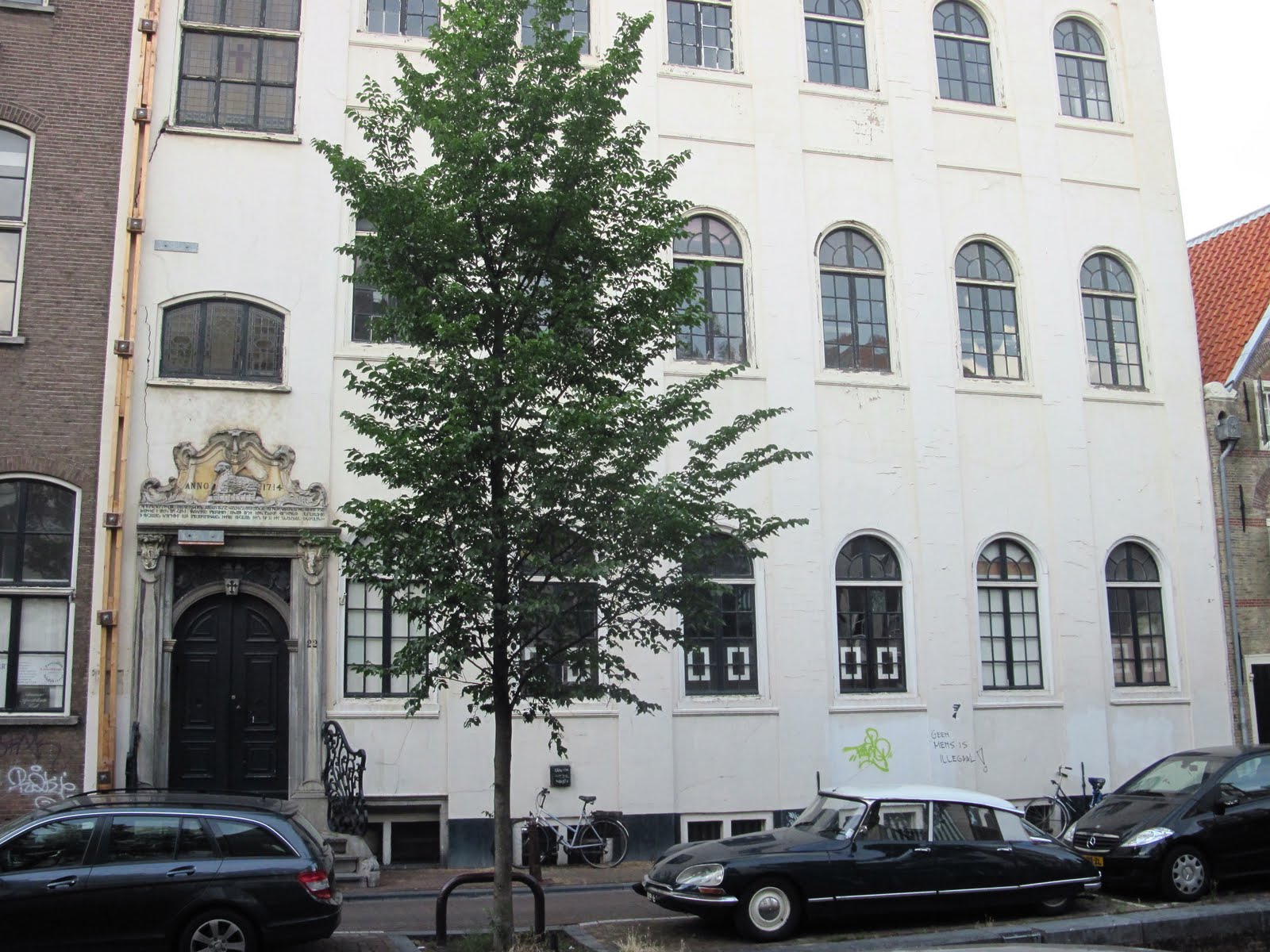
Armeens Apostolische Kerk, the Armenian Apostolic Church of Amsterdam, Soorp Hoki (Holy Spirit) was built in 1715, at a time when Holland was at the height of its reach around the world. The Dutch merchant navy ruled the waves, and Holland controlled the trade routes all the way from Indonesia to the capitals of Europe, and a resourceful class of Armenian merchants from the Ottoman and Persian Empires played a pivotal role in moving pearls, diamonds, rugs, textile and spices between continents as early as the sixteenth century.

A parallel story had developed with another merchant class of Armenians- Those who had played an equally important role in the acquisition and foundation of the Mekhitarist monastery on the island of San Lazaro in Venice. Incidentally, those were Armenians of the Catholic denomination. Who knows, they may have been in a competition with the founders of Soorp Hoki at the time. For all we know, the different groups may have looked at the two churches as “theirs” and “ours”, much the same way Armenians react to two churches to this day.

By the middle of the nineteenth century, the Armenian church of Amsterdam was closed down, and eventually sold. Wars and conflicts, particularly the blockade of Holland during the Napoleonic Wars had taken its toll on the Armenian merchant class that thrived on the free movement of goods across the world. The emergence of the British Empire and English trading companies has resulted in further loss of economic power of the Armenian community of Amsterdam.

I found myself in Amsterdam in the mid 80’s, as a traveler between continents. I visited the church escorted by a bolsahye whom I had met by chance roaming one of the city squares. When two Armenians meet anywhere in the world, they… well, they explore the local church I guess! The community had obviously grown, as Armenians had once again moved to Amsterdam and eventually repurchased the same church. A remarkable story, and a mark of pride and joy.

The church was located on a canal in the heart of the old city. I was impressed by the interior- clear, thick, white walls, covered with beautiful hand-painted murals. A small khoran, and original tinted glass windows. Nothing grandiose, simply small, intimate, and beautiful. A true gem oozing with history. I could almost feel the footsteps of past generations of Armenians walking its isles. When done touring, my guide then walked me through (and past) the must-see Red Light district to meet with other Armenians for a “Who are you”, “Where were you born” type of conversation. That’s Amsterdam for you!

I was again in Amsterdam last month, this time with my family. I made a point to take them to see the small Armenian church on the canal. A phone call by the hotel concierge was fruitless, as we were told that the church does not accept visitors. I thought that an Armenian doesn’t need an invitation to visit his own church- so first thing in the morning, I gathered my family, hailed a cab and headed to Krom Boomssloot 22.

There it was, the white husky building, three stories high, located (as I remembered) on a quiet tree-lined street right on the canal.

Knock on the door. No answer.

Knock again, still no answer. Something was not right... as it turned out that it wasn’t.

Luckily, Amsterdam is full of friendly next-door neighbors willing to help. This one was a wine merchant by the entrance to the next building. I asked if the Armenian church was open. He said, “Ya, but the building is not good”. “What do you mean it’s not good?” I asked. “Well, it’s sinking. It’s sinking into the canal”. He demonstrated “sinking” by holding his palms downward in an up-and-down motion.

When asked if mass was being held on Sundays, the answer was an emphatic “No”.

I had no words when I met my family outside. I just shook my head, meaning “No, it’s not open”. Is this what we have to deal with? I thought. Another national treasure condemned to be abandoned, and forgotten? I’m sure it too was built by people with the best of Armenian intentions, alas no one left to save their dream.

Back in Los Angeles, I cannot help but think about the small church on the canal as I drive past the big church on the freeway. Let’s not forget the past; we may end up living it again… much, much (much) sooner than three hundred years from now.

I do not wish to dismissively shake my head about an Armenian church again. It hurts too much!

May 9, 2010

Dear Mom

My mother Sonia with her twins, ages 3
I’m gasping for words on this day, the day I’m expected to be at my best to say something about the heart, from the heart, and to thank my mother on Mother’s Day. Thoughts abide… nothing but good thoughts, I assure you. Graceful thoughts of a grateful son.

It must be care and nurturing that I want to thank her for, guidance and ideas as well; for bidding me farewell at times and welcoming me home all the time, and for inspiring me to dream… Armenian dreams, in the colors and sounds of the world. I must not leave out her mentorship, scholarship and advice, or the caution and protection rendered. But the noblest of them all has to be love, endless and unconditional.

For someone who rarely misses out on words… I am short on them today. Emotions overwhelm me.
Allow me to instead have the poet of my people say it… as I would have wanted it said- mildly and gently.

A MOTHER’S HEART
By Avedik Issahakian

There is an old tale
About a boy
An only son
Who fell in love with a lass.

“You don’t love me,
You never did,” said she to him.
“But if you do, go then
And fetch me your mother’s heart.”

Downcast and distraught
The boy walked off
And after shedding copious tears
Came back to his love.

The girl was angry
When she saw him thus
And said, “Don’t you dare come back again
Without your mother’s heart.”

The boy went and killed
A mountain roe deer
And offered its heart
To the one he adored.

But again she was angry
And said, “Get out of my sight.
I told you what I want
Is your mother’s heart.”

The boy went and killed
His mother, and as he ran
With her heart in his hand
He slipped and fell.

"My dear child,
My poor child,”
Cried the mother’s heart,
“Did you hurt yourself?”

Happy Mother’s Day to all, and to one of the brightest of them all: the mother of mine.

April 24, 2010

Reflections on April 24

The reasons why I’m convinced that I must persist with full awareness of the Armenian Genocide are rooted in my education, upbringing, and convictions. I would like to share some of them with you.

1- Reason one is because Prof. Vahakn Dadrian says so. The proofs of premeditation, intent to destroy, organization and execution of the Genocide are in his books, all based on archival documents. Turks are yet to produce a single evidence to prove their own twisted version of Ottoman deeds. Sadly, the fifth element to any crime in the cover-up, and more proofs are in documents hidden in storages by the Turkish government to this day. No one would love to get his hands on them more than Dadrian himself.

2- Turkey is reason number two. The more they lie, the more the world is determined to keep on asking them “the” question over and over again. (Note CNN’s last interview with Turkish PM Erdogan, where the question of Genocide came up persistently during a brief 10 minute-long interview).
Turkish illusions of grandeur and regional superiority is a dangerous thing, and nothing serves them better that to face their own past, and be reminded by each line of questioning that they are not so great after all. The world will be a better place if Turkey was to calm down, look back, settle the affairs of the past, negotiate its place in the region, and only then venture out with the resemblance of founded claims to power.

3- Erdogan, Gul and Davutoglu are reason number three- they are gung-ho to explain to the civilized world, that what happened in Turkey between 1915-1921 was a massacre, and not a genocide (“we do not agree to this G word”, they keep saying). They leave me no choice but to explain to them a comparative study on mass killings: A massacre is actually what happened in America during depression-era Chicago in 1929, when the notorious mobster Al Capone gunned down mere six (6) goons of an opposing gang in what became to be known as the St. Valentine’s Day …Massacre. That was a massacre! Also note that in 2004 the President of the United States referred to the killings in Darfur as… genocide, right when the deaths from that conflict had reached not the 1.5 million mark, but rather a much lower three hundred thousand mark. Now you make the connections.

4- Countries around the world are researching the history of man’s cruelty towards man and… finding it, in the Armenian Genocide. Many others will permit the same questions, and come to answers where the truth is. As in Switzerland, other countries too will join the ranks of civilized societies that will set into law the denial of the Armenian Genocide as a crime, and deniers as criminals.

5- The Genocide is part of the Armenian identity. We didn’t ask for it, it fell upon us. Identity is the basis upon which people design their own self-preservation. In our case, the Genocide is in the center of it.
We had to live with the Genocide for 95 years, we had no choice. And frankly the call to “Move on with it” is not for politicians, businessmen or journalists to make. Those who promote that line of thinking are claiming for themselves a piece of luxury that they do not own. Individuals may make personal choices; nation on the other hand, can act only upon the collective experience, at least democratic ones do.

6- It’s the neighborhood dude. The leaders of Turkey are acting as if their country appeared on the world stage one day where there was no Armenia, and no Armenians or stories of Armenians in their eastern provinces. Not so. The story of Armenians and Turkey is not over yet. Our thousand-years-old dealings with each other have been disrupted and adulterated, but not eliminated. Armenians will feature in many vital Turkish issues and dealings in years to come, and Armenian demands will constantly be raised, sometimes by multitudes, other times by mere solitary voices. Turkey will choose to neglect, reject or abandon, and we already know that. We will be back another time to continue where we left off. We have the long view of history, after all we survived 600 years of Ottoman misery, and we learned a thing or two about enduring them.

7- As long as Turkey pursues a policy of denial, Genocide recognition remains Armenia’s primary case for security vis-a-vis Turkey. The day Armenia relinquishes calls for human rights and Genocide recognition is the day Armenia will cease to value itself as a full nation. All legitimate nations with their unique place in the present arrangement of things, and a view of their future learn and grown from their own past. That’s the enduring trait of all ancient civilizations, and ours is not different.
The Genocide as a human rights issue is Turkey’s burden, and Armenia’s salvation. Without it neither country will possess the future that they aspire to, independently of each other or together.

8- The youth inspire me, and give me hope. Attend any current events function, and you will see them and meet them. Educated, savvy and eloquent, with no inhibitions to challenge the establishment, to ask questions, rally a crowd, or carry the message. These are the grandchildren and great-grandchildren of the survivor generation, and the pursuit of “the cause” is theirs. I have full confidence in them. Their determination is contagious, and in time more will join them from an emerging young educated class of Armenia. It is a matter of time.

9- For a significant part of the last 95 years V. Dadrian, as well as R. Hovannisian, P. Balakian and others have done immensely valuable work in documenting the Genocide, yet historians have barely entered the realm of the 2 most extensive archives not yet exposed: Turkish and German. There’s work to be done.

10- It’s personal. You bet it is!
I am intermittently reminded of my place in the world and a responsibility that comes to a descendant of the Genocide generation- by my grandfather Mesrob Chinchinian of Marash and my grandmother Mari Manoushagian of Aintab; and my paternal grandparents Artin Gulvartian, who died on the evacuation route from Hajin to Adana, and his young wife Teshgouhi Saghdasarian who lamented his untimely death for the rest of her life.

I rest my case!

April 9, 2010

Start Talking!

We, Armenians in Los Angeles, have been basking in an illusionary image of ourselves for quite some time. We have been acting carelessly as happy-go-lucky chums at the expense of a mirage of economic prosperity without paying attention to the responsibilities that inevitably came with it. We can do something about it- not as much as to solve problems, but to devise a “wish list” or a “must do list”- things that will improve our value and significance as a community.


It is time to change course, and to start talking. This task is entrusted to the pillar institutions of our society: Traditionally, the goosagtsutunes (politicos), the church, newspapers, schools, and the intellectual elite.

Fifteen years of a laissez-faire attitude, has blurred the role of these pillar institutions. As a result, unexpected outsiders have moved into traditional roles expected of others to address and perform, thus confusing the outcome, and weakening our aim to grab one voice from a position of cooperation.

While things seem to be okay from the outset, in reality we face serious problems: Loss of vibrant intellectual discourse, diminishing spirituality in the religious context, schools in crisis, the disappearance of Armenian-language literary expression and output, and a forgetfulness about what to do for the youth, especially for those between the ages of 22 and 32 (I call them, “the forgotten”).

It will be difficult to find solutions, but it would be wise to at least start talking. Talk about the problems; talk with the people who have assumed the role to provide solutions. They are the men and women in charge of the pillar institutions that past generations have laboriously created, organized or financed for the purpose of our preservation and survival.

If left to a discussion, many people can come up with as many pillar institutions that they each deem more important in the larger agenda. I will take up only four of them for the purpose of this column.

Political parties have proven their ability to organize large number of people around projects, programs and activities, Genocide remembrance and recognition as one of the most important of them. But it takes leaders (especially the ones at the top of the pyramid) with special character to rally a wide consensus, by sharing the responsibilities and the rewards for real victory. Collective effort can exponentially magnify the results if activists sat down to talk about a plan which, I’m sure, does not differ from the other's: How to get the message to the US Congress; how to gear Armenia’s foreign and domestic policies towards Armenocentric aims; how to address problems afflicting the youth; and of course, the Genocide and how to check on a Turkey-gone-wild with denial.

Alas our political entities are stuck in rhetoric rooted in old cold war suspicions, some of which are directed against each other. The cold war ended twenty years ago, and it’s time for change. Meet with each other regularly, and talk incessantly, to draw out new action plans for success. Act, and claim the legitimacy as “the” voice of all the people.

The Church remains stuck in an artificial “one-ship-two-captain” situation (The ship is very small, mind you, and very fragile), since the days of caustic cold war era divisions which the world has since resolved and forgotten… except for us Armenians (When we fight, we fight real goooood!). Territorialism is exhausting and devouring the communities and it’s sad to even imagine what we should be doing instead.

I celebrate the success of the Armenian Church, not by the physical number of churches across the American landscape, but rather by the declining number of Armenians in prisons, or simply by the number of American-born young men who choose the church as their career path. The business of religion is not a zero sum game; the loss of one is not gain to another. Faith and prayer is not a matter of competition, and they are not commodities sold out of shops. It is a matter of laborious teaching, role-modeling and a sense of mission. It’s hard and serious work.

I hope that the clergy of all persuasions will always gather to talk about what is worthy of discussion: An agreement to teach faith, spirituality, good citizenship, and Armenianess in its various forms and shapes- marriage and family, language, customs and traditions, church history, saints, and the sublime art of praying and paying attention to the badarak.

Armenian Schools are in difficulty, and they are losing supporters and numbers. The cause that worries me most is not financial or related to the economy. We are facing a loss of faith in Armenian schools brought about by a combination of changing popular priorities during a period of financial prosperity, and new unchallenged perceptions as to what is necessary to bring up a child as an Armenian.

While families are making drastic decisions about the place of organized Armenian education in their children’s lives, the schools themselves are still debating who is the ideal (dibar) graduate of an Armenian school. What is the new message from the schools? Is it loud enough? Is it clear enough?

The time for principals of Armenian schools to meet, and to talk is now! It is absolutely essential that a common plan be devised immediately. Come up with a revised mission statement and then deliver. The failure of even one school is the failure of Armenian education as the last remaining potent experiment of the self-preservation process of our times.

Academics is a term in reference to the collective work done by historians, researchers and intellectuals to document the story of the Armenian people, Genocide historiography being the most contemporary and important. While too much emphasis is placed on politicians to “teach the Turks a lesson in history”, in reality the fight for Genocide recognition is won by the work of the intellectual elite.

Academicians are the least accessible segment of the pillar institutions. They are men and women whose work is above and beyond the reach of the general population, and for good reason. But, that doesn’t mean that they can be insulated from the needs of the Armenian community and people. Therefore, I can only hope that they meet regularly, and talk about their work and the work of all other researchers; to advance the career of young scholars- to promote them in institutions of higher learning with access to a forum for discussions and publications. I hope that a new generation will soon replace those who must pave the path for the young to continue the most important work of our (and the next) generation.

I feel that there is a slimmer of hope these days. Lately groups have been forming across LA, to meet and discuss all issues that pertain to our interests in the world at this particular time in history- There is now talk where there was none before, and I am hopeful. The purpose, I think, is to eventually draw out a list of what the people want, need and demand. But for the time being the message is very simple: Start talking!

In time, I expect more will join the discussions in many more small (formal, organized of otherwise) groups across all communities. I hope everyone- journalists, artists, politicos, the clergy, educators entrepreneurs and academicians alike- will join… and start talking!